
Meet the Printmaker: Alexandra Motiu | Artist in Focus | Southbank Printmakers | 3rd - 16th of August 2026
Updated: Aug 16
Alexandra Motiu is our newest member, and our Artist in Focus in August here in the gallery. She is a relief printmaker who works with linocut, woodcut, and wood engraving, and makes detailed prints based on stories, creating unique worlds to get lost in. We hope you enjoy this interview where she kindly shared so much of the inspiration behind her prints.

Could you tell us a little about yourself and how you first came to printmaking?
I am a relief printmaker, making linocut, woodcut, and wood engraving prints primarily. I am Romanian, but I moved to the UK when I was 15, so I have now officially spent half my life in either place.
I was introduced to printmaking in my teens by Romanian painter and printmaker Matei Serban Sandu. I spent time in his studio over a couple of years then and he taught me how to make etchings, drypoint, monotype and even photogravure.
I then went to university and mine was a very conceptual course, heavily based on art theory, so I made different work, experimented a lot with collage, and made a lot of relational artworks where the public was invited to participate.
When I finished my course, I took a break from my art and worked in different arts organisations a lot. When I came back to it, I remembered some printmaking principles, and started making linocut prints, as they are the friendliest to make at home. I started documenting the process and my business started growing seemingly out of nowhere!

Did you have a formal art education, or has your practice developed in other ways?
I studied Fine Art Critical Practice at Brighton University for my BA. I took some years off and then started printmaking, so when it came to my MA, I chose Camberwell College at University of the Arts London for their printmaking facilities and did an MA in Illustration.
Otherwise, my practice has developed through a lot of experimentation. When I started, I made close to 200 prints per year for a couple of years. And my journey continues as printmaking techniques are never-ending, and finding innovative ways of working is always possible.

How has your background shaped the work you make today?
My MA project was monumental, as I worked with The Bishopsgate archive and looked at the history of printmaking as a trade, particularly at The Wapping Dispute. I made many prints illustrating some of the stories I found in the archive, and a lot of what I learned about the spirit of print is carrying me through.
My more relational artwork during my BA cemented my wish to keep working with the public, and with printmaking I found it even more instrumental, as I am so adamant about preserving the entirety of this craft and passing it on.
I also have a background in painting, and visually always admired modern movements such as the surrealists. This manifested in a love for drawing from life, so most of my work is inspired by real life models. Portraiture is somehow always at the core of my work, which then extends into interesting characters, real or imagined. I also have a strong reverence for the Arts and Crafts movement, so ultimately my prints end up being symbolic and decorative as well, with a strong folk influence.

What initially drew you to printmaking over other artistic mediums?
I enjoy the limitations of the medium. I often think that if artists aren’t making enough work, it is because they haven’t found their medium. It suits me so well, as I have a busy mind, which often manifested in busy artwork, and I have a real problem with editing.
Printmaking however then has limits, there are limits in what you can carve, what you can print, how many colours you can layer. It forces you to think in separate stages which forces you to edit things to make the print work. I could still use my colour mixing skills from my painting days, but with such an even, graphic result.
I enjoy the process from beginning to end, the laborious nature of it keeps me very satisfied, I like how physical it is. I often had a problem with conceptual art which most of the time leaves the production of it to someone else. I like feeling like I am working for my art myself.
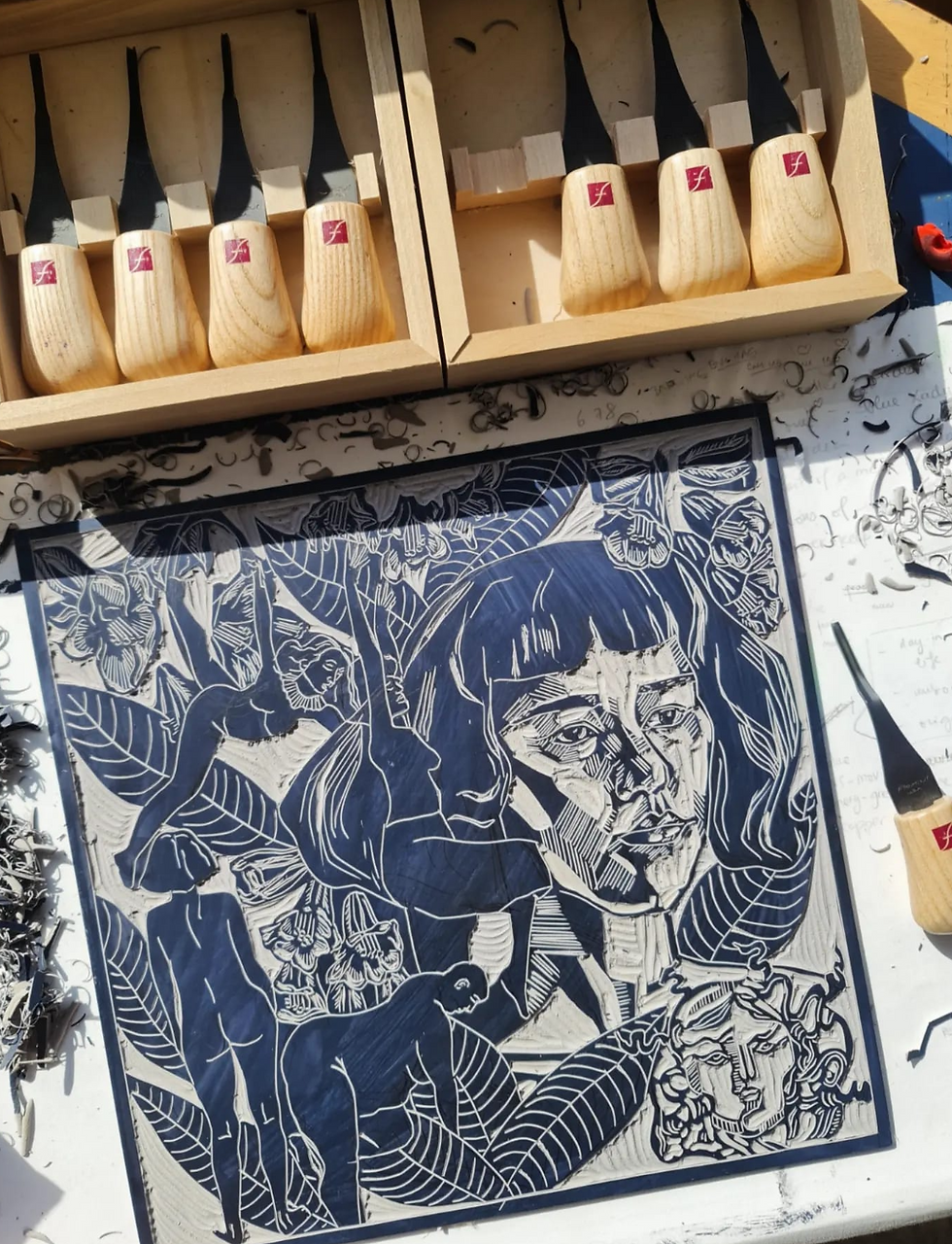
Could you describe the printmaking process and the techniques you most enjoy working with?
I make linocut, woodcut, and wood engraving prints. You use special knives and tools to carve the image out, and where you carve the image will remain white. You then roll ink on top of the block and print it.
It feels like an endless medium as you can also layer blocks, and make multiblock prints, or make reduction prints, where you keep cutting into the same block, and printing different layers, until the block is gone.
You often have to think backwards when working which is fun, as you are working with light, and the image will also be backwards.

What subject or themes continually find their way into your work?
Stories are always at the core of my work, be they real or imagined. I have series where I start from a portrait, and while I’m drawing them I imagine their dreams and ideals. Then I place them into this dream like world where every symbol relates to my imagined story.
I have prints based on folk stories and myths, some of Romanian influence, and some Greek mythology. I made prints inspired by medieval art and customs. I have some prints based on The Neverending Story by Michael Ende, and I also have a series of prints where I illustrated a surreal narrative poetry book by my friend Ricardo Reveron Blanco.
Many of my prints contain an invented alphabet of symbols and ideals, often recurring. I also have my series based on real stories of people from the past who have fought through labour rights related movements, and they often include the same dream-like alphabet of recurring symbols.

Where do you tend to find inspiration?
Life drawing is my main source of inspiration, as well as nature. Of course, also art books, especially those of sister crafts like textile patterns and tapestries. Going to museums and art galleries is something I do regularly. And carrying on reading stories, literature, watching movies. Recently I have been doing a lot of research looking into Romanian folk symbolism, and our national textile patterns from different areas around the country.

Is there a particular piece in this exhibition that feels especially meaningful to you? What is the story behind it?
I always love any of my prints based on The Circus. In Brighton there is a group of performers who dress up for the purpose of being drawn called The Drawing Circus, and they have been an endless resource for me.
The circus as a theme is inspiring as our oddities and eccentricities become talents to capitalise on, and in doing so, it almost seems to be a practice of protest the society that has marginalised those oddities in the first place.
However, you are of course still a part of society, and it is still a job, so most of my characters will be sad or bored. There is something haunting to me about a performer in their time off, after the show, after they have given so much. Perhaps I often relate to these characters, as there is so much performing we have to do ourselves these days.

Has your work or artistic approach changed significantly over time?
I see my work as ever evolving, as I learn new techniques, and find different and personal ways of combining them. Technically I am sure I also evolve, but the core approach stays the same to me, where I am more interested in the process than the final piece.
I love working with a new medium, new tools, and materials, learning their quirks, and creating a personal process relating to which “mistakes” I allow as part of the limitation of the medium, and which I correct. I am grateful to be able to work in my own studio, and to be free of a lot of printmaking conventions, even though I do stay faithful and respectful to the techniques in many ways.
What are the artists, printmakers, and creative influences that have shaped your practice?
There are way too many to count! I am inspired by The Arts and Crafts movement in its entirety, William Morris, Walter Crane, Ann Macbeth. I admire many printmakers who make work with a social purpose, both contemporary and of the past, like Kathe Kollwitz and Ysidro Pergamino.
I like art projects that make work visible, like Mierle Laderman Ukeles, Stuart whipps The Mini Factory, or the work of Tehching Hsieh. I do think printmaking has some spirit of the autodestructive art of Gustav Metzger, as the block should be destroyed after an edition is printed, and you are working towards carefully carving an object which in itself is not the final artwork.
I always loved the Dada movement, my favourite artist being Hannach Hoch. I often liked the Chapman Brothers, especially their printmaking. I recently saw the Friday Khalo exhibition at Tate Modern and was of course in awe of her work, and surprised at how much craft and folk customs were a part of it.

What are you currently exploring or working towards in your practice?
I am currently focused on working with wood, on a large scale and smaller scale. I am also working on advancing my journey into making more multiblock prints. And I am trying to learn how to make repeat patterns, as I am dreaming of textile patterns that are more figurative, which could contain characters, people, and dancing bodies.
What do you hope people notice or feel when they spend time with your work?
I always hope that my work can quiet a busy mind, through the fact that the compositions are busy themselves, as it does for me.
I hope that people like the decorative aspects in it as well, and ultimately that they return to it time and time again and find something new in it.

Alexandra's Artist in Focus will be on in the gallery from the 3rd - 16th of August 2026. You can purchase her prints online in our shop here. And you can stay up to date with any of our events, private views and workshops here, or by subscribing to our newsletter.
Meet the Printmaker’s description of Alexandra Motiu gives us a great chance to learn about printmaking as well as how the creative process of the artist works. As a student, it is interesting to see how artists think of ideas using different means while Ghost writing UK demonstrates how creative people can contribute to making ideas interesting stories.
What stood out to me is how printmaking keeps the physical process central to the artist’s work , i mean you really see it. When I saw the texture, the paper choice , the ink, and those repeated impressions in person it felt like the tiny details pop, the digital images miss . And that connection between creative practice and documented research is kinda interesting too. Because both artists and academics benefit from preserving their work carefully , like holding on to it the right way. Even thesis journal publication Canada projects can involve thoughtful choices around print quality and how it’s presented, particularly for visual research .